
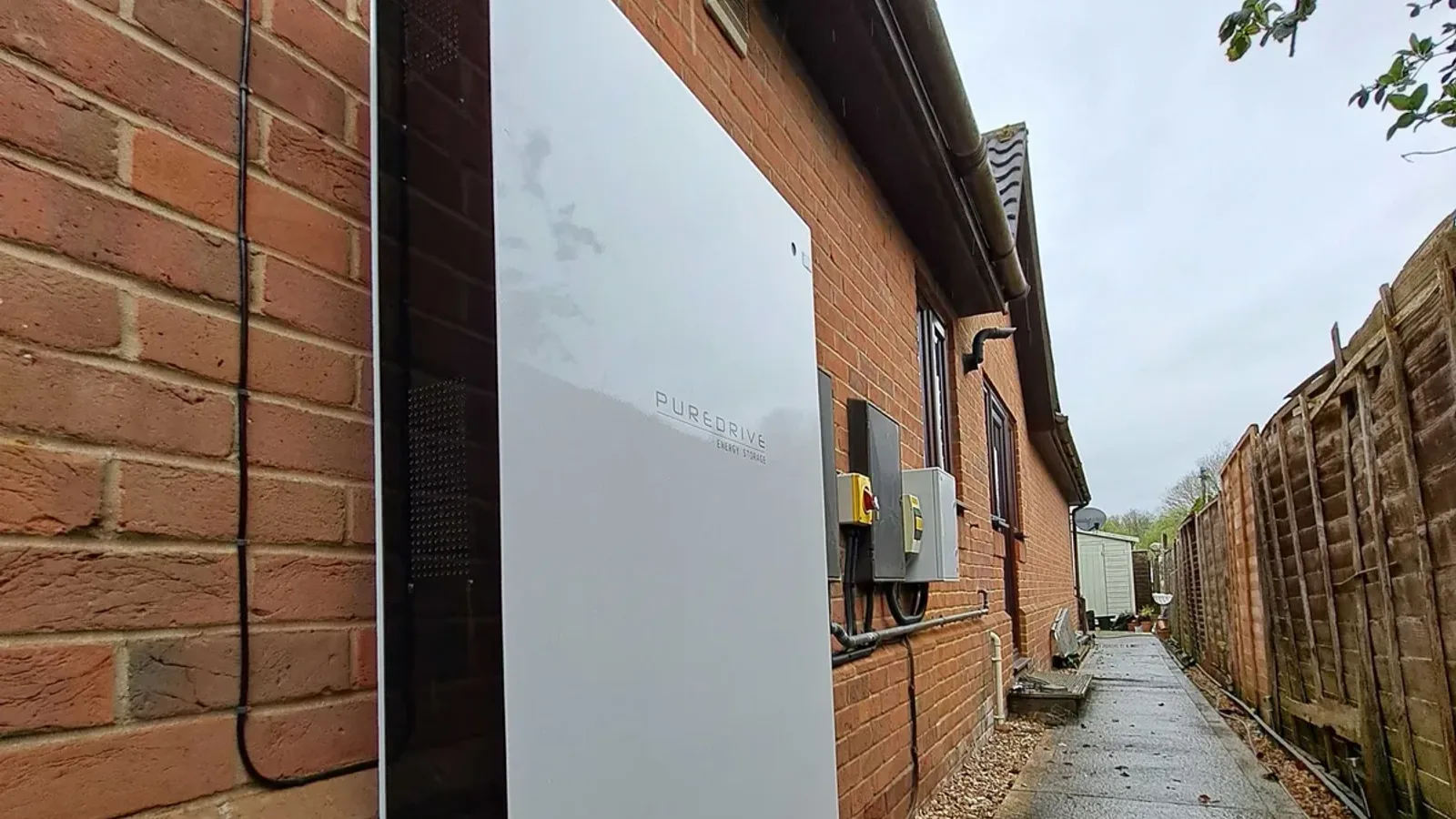
A battery does not need solar panels to be useful. It needs a tariff with a cheap window in it.
Battery-only installations are something we are asked about more and more, usually by people who want the benefit of storage but cannot or do not want to put panels on the roof. It is a legitimate installation and we fit them, but it works on a different principle to a solar battery, and it is worth understanding which before you commit.
Key Takeaways
- A battery works perfectly well without panels
- It charges from the grid in a cheap off-peak window instead of from a roof
- The saving comes from the price difference between off-peak and peak rates
- It only makes sense on a time-of-use tariff
- It can also provide backup during a power cut, if designed to
How It Works Without Solar
With solar, a battery stores electricity you have generated so you can use it later instead of exporting it.
Without solar, the battery does the same job with a different source. It charges from the grid during whatever cheap window your tariff offers, usually overnight, and then powers the house through the expensive part of the day. You are not generating anything. You are buying electricity at the low rate and using it at the time you would otherwise have paid the high rate.
That is the whole mechanism, and it is why the tariff matters more than anything else.
You Need The Right Tariff
On a single flat rate tariff, a battery-only installation has nothing to work with. Electricity costs the same at three in the morning as it does at six in the evening, so moving your consumption around saves nothing.
On a time-of-use tariff, where there is a defined cheap window and a higher day rate, the gap between the two is what the battery is monetising. The larger that gap, the more a battery does for you.
Rates and tariff structures change regularly, and they vary between suppliers, so check what is currently available rather than relying on a figure in an article. What matters for the decision is the shape of the tariff, not the exact pence.
We will not give you a payback figure. It depends on your tariff, your consumption, how much of it falls in the expensive window and what you pay for the system. Anyone quoting a confident number of years without having seen your electricity usage is guessing, and the honest version of that calculation needs your actual data.
What A Battery-Only System Does Well
Shifting your usage. The household runs on cheap electricity during expensive hours, without anyone changing their behaviour.
Covering the evening peak. Early evening is when most homes draw hardest and when the standard rate is usually highest.
Backup during a power cut, if the system is designed for it. This has to be specified deliberately and normally covers selected essential circuits rather than the whole property. It does not come automatically with every battery, so ask.
Charging an electric car more cheaply, in some setups. This is worth a careful conversation rather than an assumption. Moving energy into a battery and back out again has losses, and a car charging directly on an off-peak tariff is often the more efficient route. Where a battery helps is covering the rest of the house during the day while the car charges overnight.
What It Does Not Do
It does not make electricity. You are still buying every unit you use. The saving is on the price, not the quantity.
It does not reduce your consumption. If anything, there is a small round-trip loss, because no battery returns quite as much as it takes in.
It does not pay for itself quickly on a flat tariff. Without a price difference to exploit, the economics do not work. This is the single most common misunderstanding we encounter.
It does not replace an upgrade your electrics actually need. A battery is added to your installation, not instead of it. If the consumer unit is at the end of its life, that comes first.
Adding Solar Later
This is worth planning for even if panels are not in the budget now.
A battery installed today can usually have solar added to it later, but how easily depends on what is specified at the outset. Some systems are designed to accept generation from day one; others make it awkward. If there is any chance of panels in future, say so when the battery is being specified, because allowing for it costs little now and is irritating to work around later.
The same applies in reverse. If you have solar panels already and are considering storage, adding a battery to an existing array is one of the more common jobs we do, and our guide on whether solar battery storage is worth it covers the sizing and the trade-offs in more detail.
Sizing A Battery Without Solar
Sizing works differently without panels.
With solar, you size the battery around how much surplus generation there is to capture. Without solar, you size it around how much electricity the household uses during the expensive hours, because that is what the battery has to cover before the next cheap window arrives.
That means your consumption pattern matters more than your roof. A household that is out all day and draws heavily in the evening has a very different requirement to one that works from home. We will look at your actual usage rather than applying a standard figure, and we will tell you where a larger battery stops earning its place.
Inverter Repairs And Existing Systems
One more thing worth saying, because it catches people out.
If you already have a system that is underperforming, the problem is often the inverter rather than the battery or the panels. Inverter repairs and upgrades are work we take on, and it is usually far cheaper than replacing a system that is otherwise sound. Some installers will not quote for it, which is why people are sometimes told the whole installation needs replacing when it does not.
Frequently Asked Questions
Can I install a battery with no solar panels at all? Yes. Battery-only installations are a normal piece of work and we carry them out. The system charges from the grid instead of from a roof.
Will it work on any electricity tariff? It will physically work, but it only makes financial sense on a time-of-use tariff with a cheap window. On a flat rate there is no price difference for the battery to exploit.
Will it keep my house running in a power cut? Only if backup is designed in, and it usually covers selected essential circuits rather than everything. Tell us what you want to stay on and we will size it around that.
Can I add panels to it later? Usually, and it is much easier if the system is specified with that in mind from the start. Mention it at the quoting stage even if solar is years away.
Are you certified to install battery storage? Yes. We are MCS Certified Installers and approved installers for SolarEdge and Sigenergy, and our solar and battery work is covered by insurance-backed guarantees.
Talk To Us About Battery Storage
We will look at your consumption, your tariff and your existing installation, and tell you honestly whether a battery-only system earns its place at your property or whether your money is better spent elsewhere.
You get a free, itemised quote with no obligation. We install battery storage, including battery-only systems, home backup and additions to existing solar, across Salisbury, Downton and the surrounding villages.