
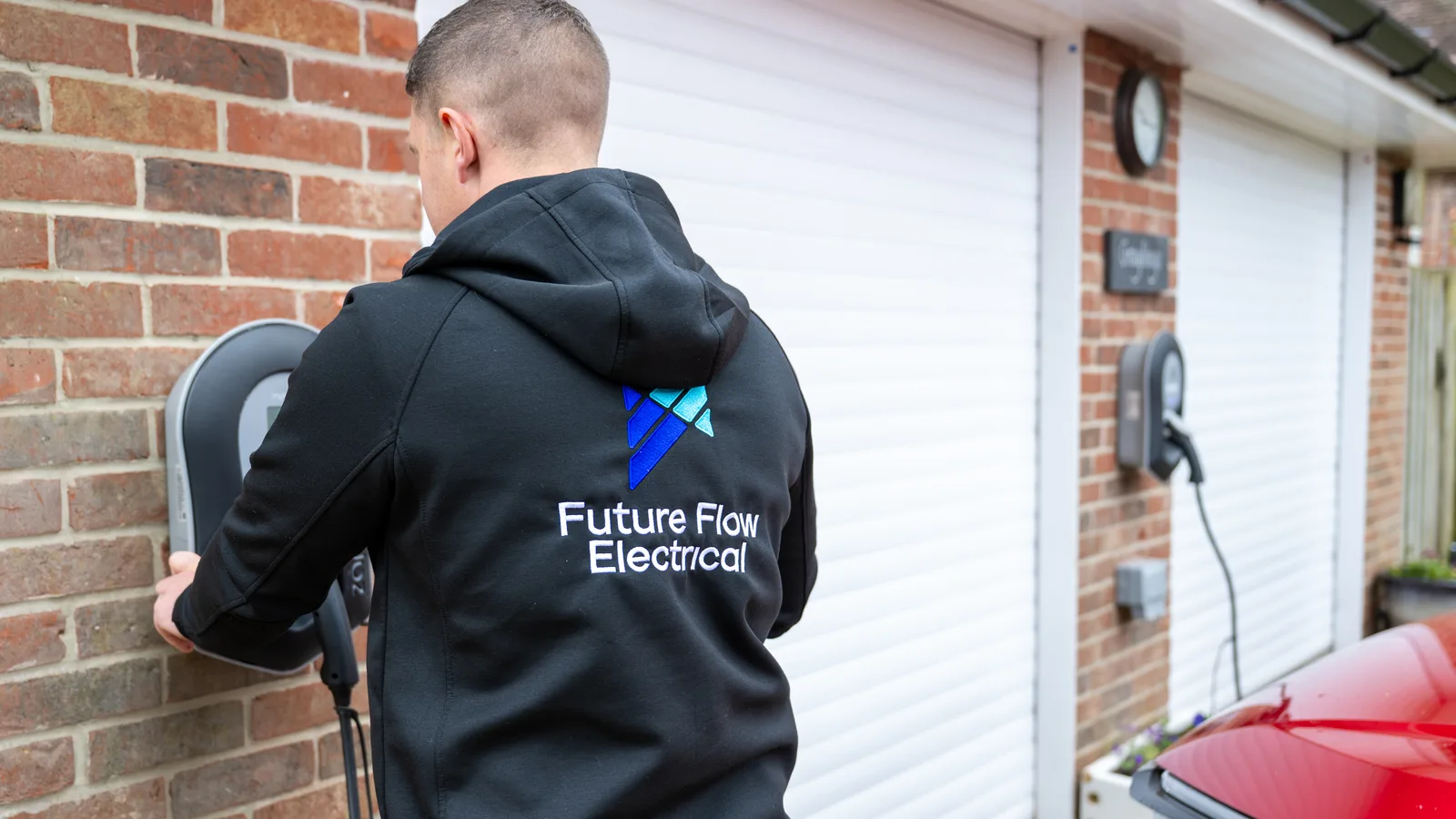
Two electric cars on one driveway is now a normal situation rather than an unusual one, and it is the question we are asked most often by households replacing a second car.
The short answer is yes. The useful answer is about what your incoming supply can deliver, because that, rather than the chargers, is what decides how it is done.
Key Takeaways
- Two cars at home is almost always achievable
- The constraint is your main fuse, not the number of charge points
- Two 7kW chargers want around 14kW together, which few homes can spare
- Load management shares the available capacity automatically
- Two separate units, one dual socket unit, or staggered charging are all valid answers
The Real Constraint Is Your Supply
A single 7kW charge point draws roughly 32 amps while it is charging. Two of them running together is around 64 amps, before the house has used anything at all.
Most UK homes have a single phase supply with a main fuse somewhere between 60 and 100 amps. On a 100 amp supply, two chargers at full output leaves very little headroom for an electric shower, an oven and a kettle arriving at the same time. On a 60 amp supply it is not possible at all without something giving way.
This is why the answer is never simply “fit a second charger”. The first thing we do is establish what your supply actually is, because everything else follows from it.
It is also why a quote given over the phone for a second charge point is worth very little. Nobody can tell you what your property will support without looking at the incoming supply and the consumer unit.
How Load Management Solves It
Load management, sometimes called load balancing or load curtailment, is a system that monitors how much the property is drawing and reduces charger output when demand rises elsewhere.
In practice it means the chargers take whatever capacity is spare. If the house is quiet overnight, both cars charge at or near full speed. If the oven and the shower come on, the chargers step down for as long as they need to and then recover. Nothing trips, and nothing needs thinking about.
Where two charge points are installed, the management can work at two levels: between the chargers and the house, and between the two chargers themselves. The second part matters, because it is what stops both units competing for the same headroom.
This is not an optional extra on most two-car installations. It is usually the thing that makes the installation possible, and it is considerably cheaper than the alternative of upgrading the incoming supply.
Two Units Or One Dual Socket Charger?
There are two sensible layouts and the right one depends on how you actually use the cars.
Two separate charge points. Each car has its own unit, in its own parking position, with load management between them. This suits households where the cars park apart, where one car needs a faster charge than the other, or where the two spaces are far enough apart that one cable could not reach both.
One unit with two sockets. A single charge point serving two vehicles, typically sharing its output between them. The practical consequence is that when both cars are plugged in, each gets roughly half the speed. For most households charging overnight that is irrelevant, because there are plenty of hours available.
Staggered charging is the third option and it is free. Smart charge points schedule charging to your off-peak window as standard, and most will let you set different windows for different vehicles. If one car does 12,000 miles a year and the other does 3,000, they do not need to charge at the same time or at the same rate.
We will talk through which of these suits your situation rather than defaulting to the most expensive one.
What About A Supply Upgrade?
Occasionally the honest answer is that the supply needs upgrading, and that is a conversation with your distribution network operator rather than with us.
It is worth knowing it is rarely the first answer. An upgrade involves the network operator, costs that vary enormously by property, and timescales measured in months. Load management achieves the same practical outcome in a day, for a fraction of the cost, on the overwhelming majority of properties.
We will tell you if we think a supply upgrade is genuinely the right route. We will not use it as an opening position.
Adding A Second Charger Later
If you have one charge point and a second car is coming, the installation is usually straightforward, but two things are worth checking.
Does your existing charger support load management? Many do. If yours does, adding a second unit that can talk to it is simpler and cheaper than replacing both.
Is there capacity at the board? A second charge point needs its own correctly protected circuit. If your consumer unit has a usable spare way, as in our Downton installation, that part is simple. If the board is full or dated, it may need attention first.
The best time to plan for a second charger is when the first one goes in, even if the second car is years away. Running a cable or leaving capacity while the ground is open or the board is accessible costs very little at that point.
What It Costs
A single EV charger installation with us starts at around £1,200 supplied and fitted, for a straightforward job where the charger goes on an external wall reasonably close to the consumer unit.
A two-car installation is a different piece of work. The cost depends on whether you are fitting one unit or two, how far each sits from the board, whether load management hardware is needed, and what the consumer unit requires. There is no single figure, and anyone quoting one without seeing the property is guessing.
Our article on what a home EV charger costs goes through the six things that move the price, and they all apply here, usually twice over.
Frequently Asked Questions
Can I charge two cars from one 7kW charger at the same time? Only if it is a dual socket unit designed for it, and both cars will charge at roughly half speed. A single socket charger charges one vehicle at a time.
Will charging two cars trip my main fuse? Not with load management in place, which is the point of it. Without it, two chargers at full output on a modest supply genuinely could, which is why we assess the supply before quoting.
Do I need three phase power for two chargers? Almost certainly not. Three phase would give you more capacity, but very few homes have it and installing it is a major undertaking. Load management on your existing single phase supply is the normal answer.
Can I charge both cars from solar? Partly, and realistically not both at full speed. A typical domestic array does not generate enough to run two chargers at once, but surplus can be directed to one vehicle while the other charges off-peak. Our guide on charging an electric car from solar and battery storage covers what to expect.
Can you add a second charger to an installation someone else did? Usually, though we will want to inspect the existing installation first and check whether it supports load management. If it was installed without that capability, the options narrow.
Talk To Us About A Two Car Installation
We assess the incoming supply, the consumer unit, where both cars park and what the cable has to cross, then recommend the layout that suits the property rather than the one that sells the most hardware.
You get a free, itemised quote covering the full scope, with no obligation. As NICEIC Approved Contractors and approved installers for Myenergi, Ohme and Sigenergy, every installation is tested, certified and left tidy.
We cover Salisbury, Downton and the surrounding villages, including Romsey, Ringwood, Fordingbridge and Amesbury.