
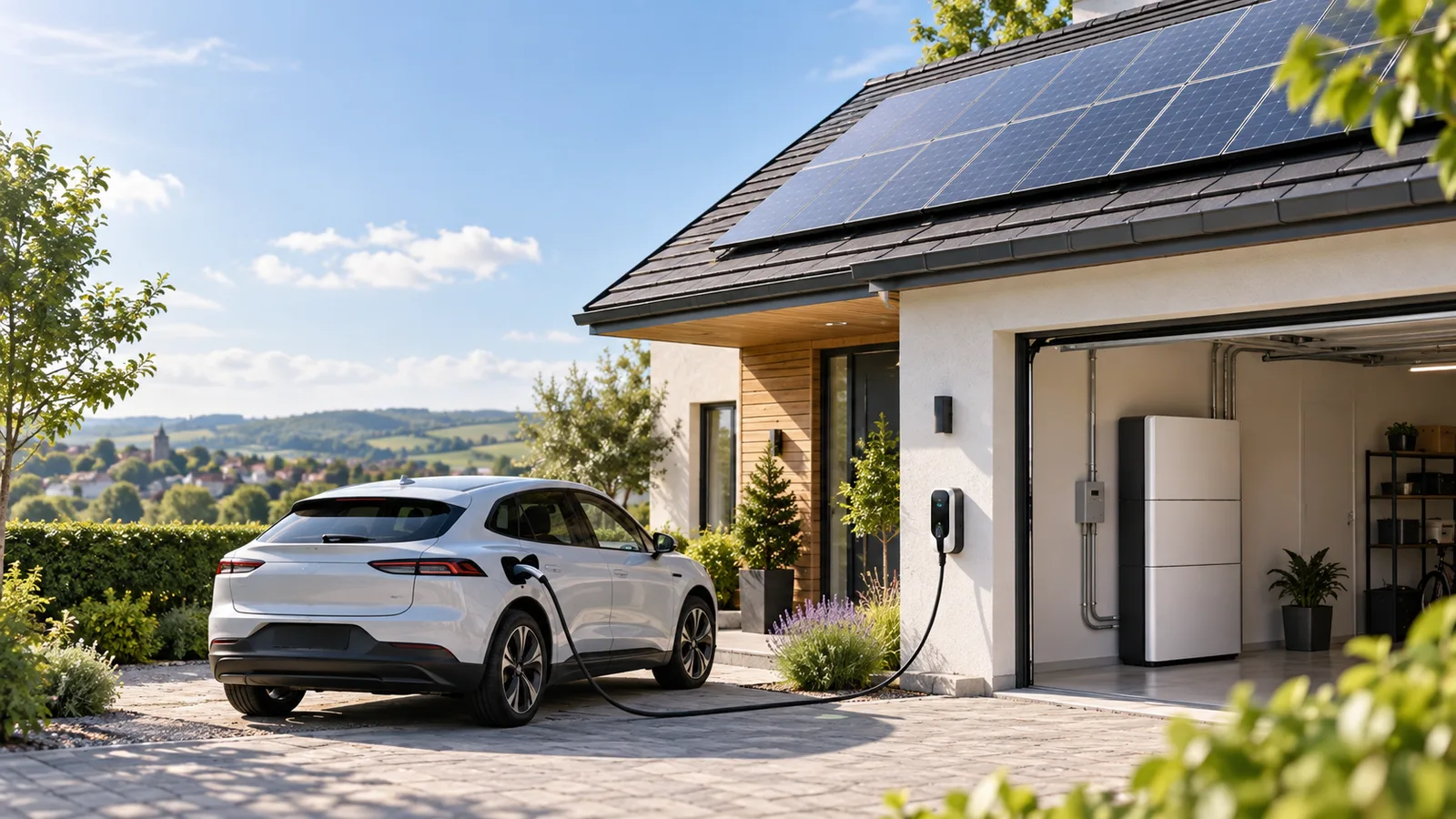
Your roof generates electricity, your car stores it, and the driving you do that week costs you nothing. The honest version is a little more involved, and it is worth understanding before you spend money.
Charging an electric car from your own solar panels is entirely possible, and once it is set up properly it is one of the most satisfying things you can do with a home energy system. It is also one of the easiest things to get wrong, usually by buying three products separately and hoping they cooperate.
This guide explains how solar, battery storage and EV charging actually work together, what you can realistically expect across a UK year, and how to design a system that delivers rather than disappoints.
Key Takeaways
- Surplus solar is worth more used at home than exported to the grid
- A solar compatible charger adjusts its charging rate to match available surplus
- A 7kW charger needs 7kW of surplus to run at full speed, which a typical array rarely produces
- Battery storage closes the gap between when solar generates and when your car is home
- A well designed system switches between solar, battery and cheap off-peak electricity automatically
- Sizing, charger choice and the supply assessment should all be planned together
Why Surplus Solar Is Worth Using Yourself
When your solar panels generate more electricity than your house is using, that surplus has to go somewhere. By default it is exported to the grid and you are paid for it under an export tariff.
The trouble is that the export rate is considerably lower than the rate you pay to buy electricity back. Every unit you export and then buy back later is a unit you have effectively sold cheap and repurchased dear.
Using that surplus yourself is worth far more, and an electric car is the single largest thing in most households capable of soaking it up.
How Solar Charging Works
A solar compatible EV charger monitors your home’s electricity flow in real time using a current transformer clamp fitted to your main incoming cable. That clamp tells the charger how much surplus is available at any moment, and the charger adjusts how fast it charges the car to match.
Most solar compatible chargers offer three modes:
- Fast. Charge at full rate regardless of where the electricity comes from. Useful when you need the car ready now.
- Eco. Use whatever solar surplus is available and top up from the grid to maintain a steady charge.
- Eco+. Use surplus solar only. If the surplus drops below the minimum the car will accept, charging pauses and resumes when the sun returns.
Eco+ is the option people picture when they imagine solar charging. It also comes with the biggest practical caveat.
The Catch Nobody Mentions
A 7kW charger running at full speed needs 7kW of surplus.
A typical domestic solar array is somewhere around 4kWp to 6kWp. On a clear June day it might approach its rated output, but your house is drawing some of that at the same time. On a grey February afternoon it might produce a few hundred watts.
There is also a floor. Most electric vehicles will not accept a charge below roughly 1.4kW, so once the surplus drops under that, charging stops entirely rather than trickling.
In practice, charging purely from live solar surplus works on bright days, in the middle of the day, in summer, when the car happens to be at home. For most working households that is not most days.
That is not an argument against solar charging. It is an argument for battery storage.
What Battery Storage Changes
A home battery breaks the timing problem.
Without storage, you can only use solar to charge your car while the sun is actually producing surplus, and most people’s cars are elsewhere at that point. With storage, the middle of the day is captured and held, and the car charges from your battery in the evening or overnight when it is on the drive.
That single change is what turns solar EV charging from an occasional weekend novelty into something that contributes meaningfully across the year.
Storage gives you a second, quieter advantage too. On a dedicated EV tariff with a cheap overnight window, you can charge the battery from the grid at the off-peak rate as well as from your panels, then run the house from it during the expensive part of the day.
The Three Ways You End Up Charging
A well designed system gives you all three and switches between them without you thinking about it.
| Where it comes from | When it works best | |
|---|---|---|
| Surplus solar | Straight from the panels | Spring to autumn, when the car is home during the day |
| Home battery | Solar stored earlier that day | Evenings and overnight, all year where generation allows |
| Off-peak grid | Cheap overnight tariff window | Winter, long journeys, and after a run of dull days |
The important point is that these are not competing options. A properly specified system uses whichever is cheapest at the time.
Dedicated EV tariffs currently offer overnight rates in the region of 7p to 9p per kWh against a standard rate several times higher. Rates change regularly, so check the current position rather than relying on a figure in an article.
Will the Car Drain My House Battery?
This is the question we get asked most, and it is a good one.
A 60kWh car battery is several times the size of a typical home battery. If you simply pointed a 7kW charger at a 10kWh home battery, you would empty it in well under two hours and leave the house with nothing.
Good quality chargers and inverters are battery aware and can be configured to prevent exactly this. They can be set to charge the car only from genuine solar surplus, leaving the home battery to do its own job, or to draw from the battery only down to a reserve level you set.
This is a specification issue rather than a fundamental limitation, but it needs designing in from the start. It is one of the clearest differences between a system put together as a whole and three products bought separately.
What Can You Realistically Expect?
A 4kWp system in the UK generates roughly 3,500 to 4,000kWh a year. If you manage to direct somewhere between 30 and 50 percent of that into your car, that is around 1,000 to 2,000kWh of driving, which depending on the vehicle is very roughly 3,000 to 7,000 miles.
The caveat matters more than the numbers. UK solar generation in December is a small fraction of what the same system produces in June, so any system designed on the assumption of even generation across the year will disappoint you between November and February.
The sensible way to think about a combined system is not that your car will run on sunshine. It is that for much of the year a significant share of your driving comes from your own roof, and for the rest of it you are charging from cheap overnight electricity instead of expensive daytime electricity. Both save money, and together they make a real difference to what running a car costs.
Designing the System as One Thing
If you are considering more than one of these, plan them together even if you install them in stages.
Sizing. If EV charging is part of the plan, the array and battery should be sized with that load included. A system specified for a household’s normal use and then asked to run a car as well will underperform.
Charger choice. Not every charge point supports solar diversion, and among those that do the implementations vary. If solar is on the horizon at all, choose a charger that supports it now.
Supply and consumer unit. Solar, battery and a charge point are three significant additions. They should be assessed together, once, rather than three times by three contractors who each assume the others left enough headroom.
Install order. There is nothing wrong with fitting the charger first and adding solar later, provided the installation is designed for it. The mistake is fitting a charger with no thought for what comes next and then paying to unpick it.
Frequently Asked Questions
Can I charge my car directly from solar without a battery? Yes, using a solar compatible charger in eco or eco+ mode. It works well on bright days when the car is home during daylight hours. Without a battery you cannot use that generation in the evening, which is when most cars are actually on the drive.
Do I need a special EV charger to use solar? You need one that supports solar diversion and works with a CT clamp to monitor surplus. Not all chargers do. If solar is part of your plans now or later, this is worth specifying from the outset.
Can I add solar to an existing EV charger installation? Usually yes, though it depends on the charger you already have and whether it supports solar diversion. We can assess the existing installation and tell you whether it can be integrated or whether the charger is the limiting factor.
Can I add a battery to solar panels I already have? In most cases yes. We assess the existing system and inverter, confirm what it can support, and advise whether a battery can be added directly or whether an inverter upgrade makes more sense. We also repair and upgrade underperforming systems.
Will this work in winter? Partly. Generation between November and February is a fraction of the summer figure, so most winter charging comes from the grid. A battery still helps, because you can fill it during a cheap overnight window and run the house from it during the day.
Is it worth doing all three at once? Often yes. One set of works, one supply assessment, and a system designed to work together from the start. If the budget only stretches to part of it now, the important thing is that what you fit first is specified for what comes later.
Getting It Right First Time
Solar, battery storage and EV charging have to talk to each other, and the awkward questions tend to fall in the gaps between contractors. We install all three ourselves, which is why we would always rather look at the whole picture before quoting on any one part of it.
We are NICEIC Approved Contractors and MCS Certified Installers with over twenty years of experience, and our solar PV and battery storage work is covered by insurance-backed guarantees. We will tell you honestly what a system will and will not do for your property before you spend anything.
If you already have solar and an EV and the two are not working together as well as you expected, that is often fixable without starting again.