
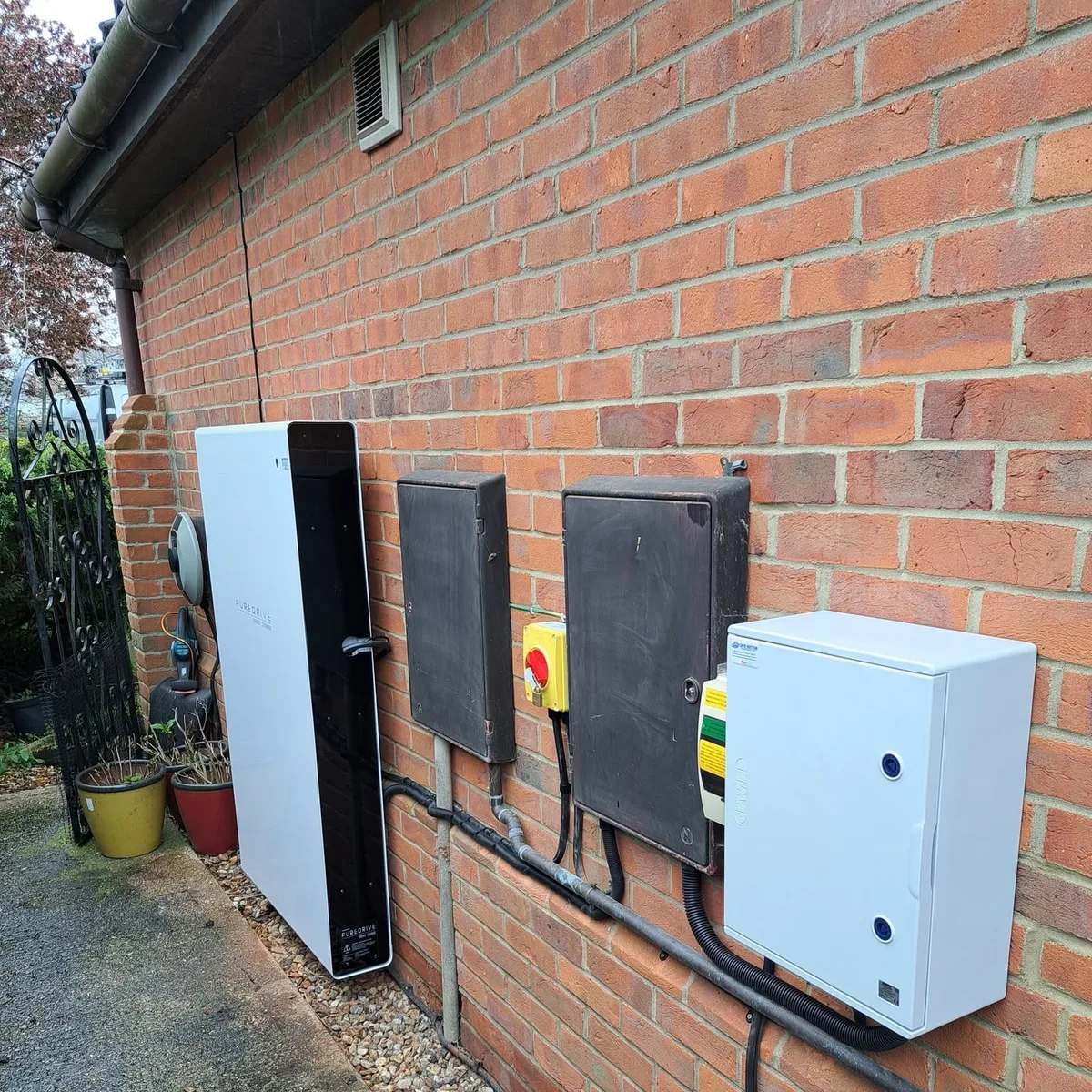
You do not need a new solar system to add storage. You need the right connection for the system you already have.
A lot of homes around Salisbury had solar fitted years ago, before batteries were a realistic option. The panels are still generating, but much of that electricity goes back to the grid during the day while the house buys it back in the evening. Adding a battery is one of the most common jobs we are asked about, and in most cases it is straightforward. The decisions that matter are about how the battery connects to what is already there.
Key Takeaways
- A battery can be added to most existing solar systems
- It connects either alongside your existing inverter (AC coupled) or through a replacement hybrid inverter (DC coupled)
- The age and condition of your current inverter usually decides which
- Size the battery around your evening use and your spare daytime generation, not the size of the roof
- Feed-in Tariff systems can take a battery, but the metering has to stay right and your FIT supplier must be told
- The installation has to be notified to your electricity network operator
Two Ways To Connect A Battery
Solar panels produce direct current (DC). Your inverter converts it to alternating current (AC) for the house. A battery can join the system on either side of that conversion.
AC Coupled
The battery comes with its own inverter and connects into the house’s AC supply, alongside the existing solar inverter. The original solar system carries on exactly as before, and the battery charges from any surplus the house is not using.
This is usually the simplest option when your existing inverter is relatively new and working well. It leaves the solar side untouched, which matters if you are on the Feed-in Tariff, because the generation meter keeps measuring the panels and nothing else.
DC Coupled (Hybrid Inverter)
The existing inverter is replaced with a hybrid inverter that manages the panels and the battery together. Solar can charge the battery directly, without converting to AC and back again, which loses a little less energy along the way.
This tends to make sense when the existing inverter is getting old. The Energy Saving Trust advises that inverters usually need replacing after around 10 to 12 years, well before the panels do. If yours is approaching that age, replacing it with a hybrid inverter now can be better value than adding a second inverter alongside one that may fail in a few years.
Checking Your Existing System First
Before recommending either route, we look at:
- The inverter. Its make, age, condition and whether it is still supported by the manufacturer
- What the panels actually generate. Monitoring data or meter readings show how much surplus there is to store
- Your consumer unit and supply. There needs to be a suitable place to connect the battery and the protection to go with it
- Where the battery can go. Garages, utility rooms and outside walls are common, but the location has to meet the manufacturer’s requirements on temperature, ventilation and access
- Any existing warranties. Adding equipment to a system installed by someone else can affect a workmanship warranty, so it is worth checking the paperwork
If the inverter is the reason a system is underperforming, that is worth fixing whichever way the battery connects. Our guide to solar inverter problems explains how to tell whether an inverter needs repairing or replacing.
Sizing The Battery
A battery is only worth what it stores and then uses. Bigger is not automatically better.
The right size depends on two things: how much surplus your panels produce on a typical day, and how much electricity the house uses in the evening and overnight. A battery much larger than either will rarely fill or rarely empty, and the extra capacity is money spent for nothing. A battery that is too small leaves surplus going to the grid for a modest return.
An older array is often smaller than a modern one, so the right battery for an existing system can be smaller than people expect. Our guide on whether solar battery storage is worth it covers the trade-offs in more detail, and if you also want the battery to charge from a cheap overnight tariff in winter, our guide to using a home battery without solar explains how that works.
If Your Panels Are On The Feed-in Tariff
Many existing systems still receive Feed-in Tariff (FIT) payments, and this is the question we are asked most.
Ofgem’s guidance is that storage can be added to a FIT installation without affecting its accreditation, provided the scheme’s requirements continue to be met. In practice the key requirement is metering: your generation meter must still record only the electricity your panels generate, not electricity that has been through the battery or come from the grid. How the battery is connected is what keeps that right, which is one reason AC coupling is common on FIT systems.
You also need to tell your FIT supplier that you have added storage. They are responsible for confirming it does not affect your payments, and they may want to know how it is connected. If your export payments are deemed rather than metered, ask them how a battery affects that before you commit.
Export Payments And Certification
If you are not on the FIT, you may be able to earn from exported electricity under the Smart Export Guarantee (SEG), where energy suppliers pay for electricity you send to the grid. A battery reduces how much you export, because more of your generation is used at home, but it does not stop you being paid for what you do export.
For solar systems up to 50kW, SEG suppliers ask for an MCS certificate or an approved equivalent. If you are adding a battery, it is worth having it installed by an MCS certified installer and certified to the MCS battery standard, so the paperwork is in order for your supplier and for any future sale of the house.
Notifying The Network Operator
Adding a battery changes what is connected to your electricity supply, and the government’s guidance is that the local distribution network operator (DNO) must be notified when battery storage is installed. Depending on the size of the system and whether the battery can export, that is either a notification after installation or an application before it. Your installer should handle this as part of the job.
What The Installation Involves
For most homes, adding a battery is a much smaller job than the original solar installation, with no work on the roof. A typical installation involves:
- Mounting the battery and, where needed, a new inverter
- Connecting it to the solar system and the consumer unit, with the correct isolation and protection
- Setting up the monitoring app so you can see generation, storage and use
- Testing, commissioning and certifying the installation
- Notifying the network operator and providing your certificates
If you want the house to keep running during a power cut, tell us at the quoting stage. Backup has to be designed in, and it usually covers selected essential circuits rather than the whole house.
Frequently Asked Questions
Can a battery be added to any solar system? Most, but not all. Very old inverters, or unusual system designs, can limit the options. We check the existing system before recommending anything.
Will adding a battery affect my Feed-in Tariff payments? It should not, provided the battery is connected so your generation meter still records only what the panels produce, and you tell your FIT supplier. Check with them before you commit, particularly if your export is deemed rather than metered.
Do I need a new inverter? Not always. An AC coupled battery has its own inverter and leaves the existing one in place. If your inverter is old or failing, replacing it with a hybrid inverter is often the better choice.
How big a battery do I need? It depends on your spare daytime generation and your evening use. We size it from your monitoring data or meter readings rather than from a standard package.
Can you add a battery to a system someone else installed? Yes. Check whether the original installer’s warranty has any conditions about alterations, and we will look at the system before quoting.
Talk To Us About Adding A Battery
We will look at your existing panels, inverter and electricity use, and tell you honestly whether a battery is worth adding and which way it should connect. As MCS Certified Installers and approved installers for SolarEdge and Sigenergy, we fit solar battery storage for new and existing solar panel systems across Salisbury, Downton and the surrounding area.
You get a free, itemised quote with no obligation.