
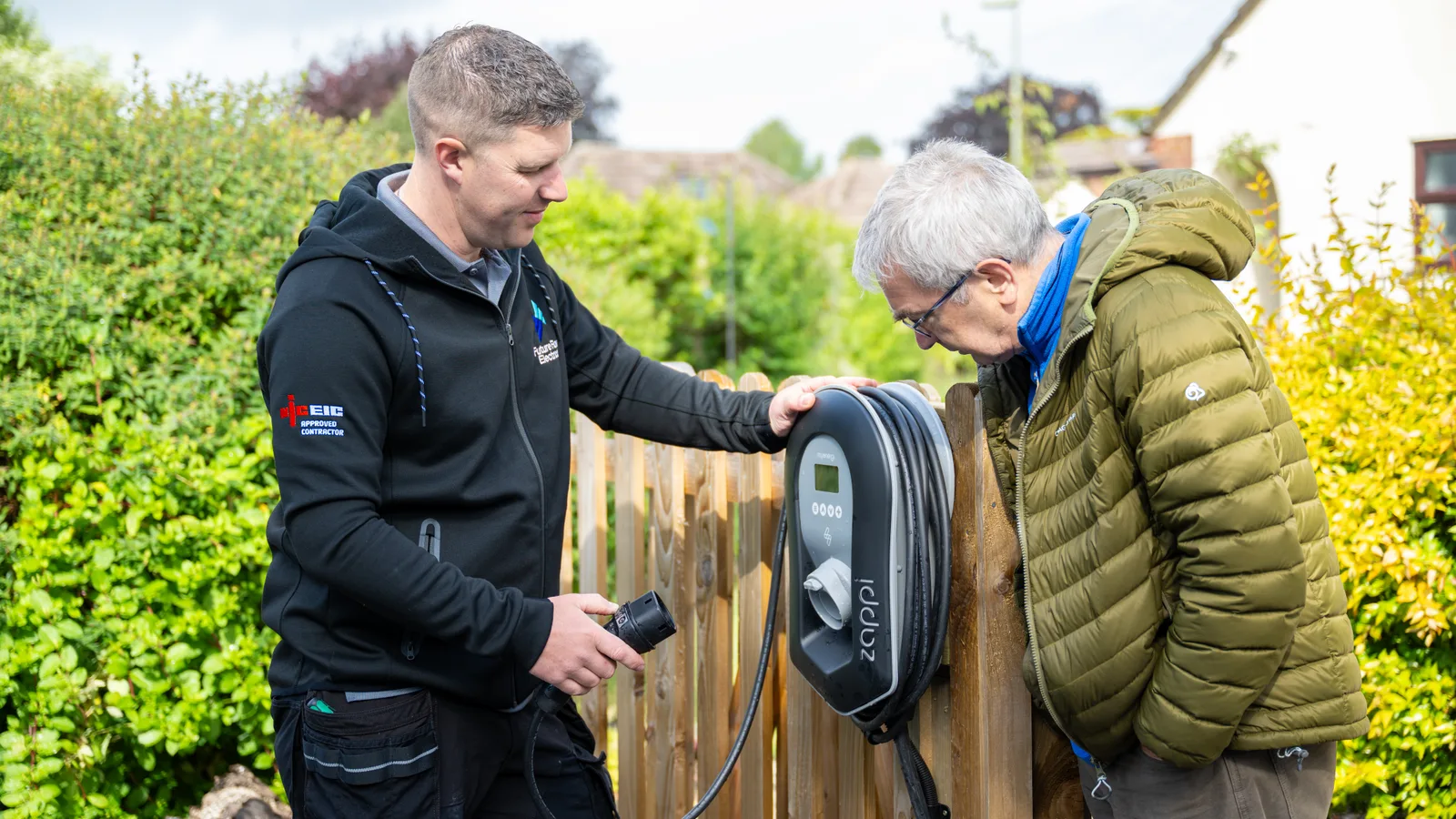
It is the first question almost everyone asks, and the one most installers dodge with "it depends".
It does depend. But that is not a useful answer when you are trying to work out whether to budget one thousand pounds or three.
So here is a straight explanation of what a home EV charger actually costs in 2026, what moves the number up and down, and what should be in a quote before you accept it.
Key Takeaways
- A properly specified installation starts at around £1,200 supplied and fitted
- The distance between your consumer unit and where you park is the biggest single variable
- Most homeowners with a private driveway are no longer eligible for the grant
- 7kW is the practical maximum on a normal single phase supply, and it is enough
- Your electricity tariff saves you far more over time than the choice of charger
The Short Answer
A properly specified home charge point installation starts at around £1,200 supplied and fitted. That is for a straightforward job: the charger goes on an external wall reasonably close to the consumer unit, the supply has capacity, and nothing needs upgrading.
Plenty of installations cost more, and where they do it is almost never because the electrician has added margin for the sake of it. It is because the property needs more work. Below is exactly what that extra work tends to be.
You will see lower figures advertised. It is worth asking what they include, because the gap is usually the supply assessment, the cable route, the consumer unit work or the certification rather than a better price on the same job.
What You Are Actually Paying For
A home charge point installation is not just a box on a wall. A properly done job includes:
- An assessment of your incoming supply, earthing arrangement and consumer unit
- A dedicated, correctly protected circuit run from your board to the charger
- The charge point itself, mounted securely and positioned sensibly
- A cable route that is protected, properly clipped or buried, and not an eyesore
- Any load management required so the charger cannot overload your supply
- Notification of the installation to your network operator where required
- Full testing, inspection and certification
- Making good afterwards, and a walkthrough of how the thing works
If a quote is substantially cheaper than everything else you have been given, it is worth asking which of the above has been left out. In our experience it is usually the supply assessment, the cable route or the certification.
The Six Things That Change The Price
1. The charge point you choose
Units vary considerably. A basic untethered charger, where you plug your own cable in each time, sits at the lower end. A tethered unit with a fixed cable costs more. Solar compatibility, load management, app control and build quality all push the price up, and the gap between the cheapest unit on the market and a well supported one from a manufacturer that will still exist in five years is usually a couple of hundred pounds.
That is not a large sum spread over the life of the installation. A charge point is a permanent, visible, weather exposed fixture that you will use every day, so it is worth buying something that will last.
2. How far the charger is from your consumer unit
This is the single biggest variable, and it is the one people underestimate most.
A charger on the outside wall directly behind your fuse board is a short cable run and a straightforward job. A charger on a detached garage forty metres away, with a driveway in between, is a different piece of work entirely. It needs correctly sized armoured cable, a considered route, and often excavation and reinstatement.
Our Ringwood installation is a good example of what that involves in practice: the supply feeding the garage was too small, so we ran a new one from the house and lifted and relaid the paving where the cable crossed the gateways.
Before you ask for a quote, it is worth walking from your consumer unit to where you park and thinking about what is in between. That walk is most of the price.
3. Whether your consumer unit needs upgrading
A charge point requires its own dedicated circuit with the right protective device. If your existing board is older, already full, or does not provide suitable protection, something has to change before a charger can be connected safely.
Sometimes that means a consumer unit upgrade. Sometimes a separate enclosure alongside the existing board is enough. Either way, it needs to be identified at the assessment stage and included in the quote, not discovered on installation day.
4. Your incoming supply and earthing
Your main supply has to be able to carry the additional load. Where it cannot comfortably, the answer is usually load management, which allows the charger to reduce its draw when the rest of the house is busy. That is a sensible, inexpensive solution and far better than finding out the hard way that the main fuse cannot cope.
There are also specific earthing requirements for outdoor charging equipment. Most modern charge points handle this internally, but on some properties additional earthing provision is needed. Again, this is an assessment question, not a surprise.
5. Groundworks and reinstatement
If the cable has to cross a driveway, a lawn or a patio, someone has to dig it, lay it, back fill it and make it good. That takes time, materials and care. It is also the part of the job where corners get cut most often, because nobody sees a badly reinstated trench until the following winter.
6. Where you live
Installation costs are noticeably higher in London and parts of the South East than in the rest of the country. Locally, in Wiltshire and Hampshire, pricing tends to sit closer to the national average, though rural properties with long cable runs push individual jobs above it.
Is There Still A Government Grant?
For most homeowners, no. This is the single biggest source of confusion we encounter.
The EV chargepoint grant currently applies to:
- People who rent their home, whether a house or a flat
- People who own and live in a flat
- Residential landlords
- Households with only on-street parking who are installing an approved cross-pavement solution
From 1 April 2026 the grant is worth up to £500 per socket, increased from £350, and the scheme is currently set to run until 31 March 2027.
Homeowners living in a house with a private driveway have not been eligible since 2022. If that describes you, budget for the full cost.
Two further points if you do qualify. The grant cannot be claimed retrospectively, and you cannot install the unit yourself. It has to go through an authorised installer who deducts the grant from your final invoice. So the time to raise it is before you accept a quote, not after the work is done.
Businesses are a separate case. The Workplace Charging Scheme is open to companies installing charge points for staff or visitors, and is worth asking about if that applies to you. We cover this on our commercial electrician page.
Grant rules change, sometimes at short notice, so always confirm the current position before committing.
What About A 22kW Charger?
Almost certainly not, and you almost certainly do not need one.
A 22kW charge point requires a three phase supply. The overwhelming majority of UK homes have a single phase supply, where 7kW is the practical maximum.
That is rarely a limitation. A 7kW charger adds roughly 25 to 30 miles of range an hour, so an overnight charge covers considerably more than the average daily drive. Most drivers plug in when they get home and leave in the morning with a full battery.
If your property does have three phase, or you are considering it as part of a larger project, it is worth discussing, but it is not something to chase for its own sake.
The Bit That Saves You The Most Money
None of the above is where the real saving is. The real saving is in running costs, and it depends on your electricity tariff far more than on which charger you buy.
Dedicated EV tariffs offer a cheap overnight window, and at the time of writing the leading rates sit at roughly 7p to 9p per kWh during that window, against a standard rate several times higher. Rates move regularly, so check the current position rather than relying on a figure in an article.
To put that in perspective, charging a 60kWh battery in an off-peak window at around 8p per kWh works out at roughly £5 for a full charge. Depending on the car, that is something in the region of 200 miles of driving. Per mile, it is a fraction of the equivalent in petrol.
The practical implication for your installation is this: make sure your charger can schedule charging to your off-peak window, and ideally that it works with your energy supplier’s smart tariff. A charger that cannot do this will cost you more over its life than the difference between a cheap unit and a good one.
Cheaper still is charging from your own generation. If you have, or are considering, solar panels and battery storage, it is worth reading how far that realistically gets you in our guide to charging an electric car from solar and battery storage.
What Should Be In Your Quote
Before you accept any quote, check it covers:
- The specific charge point make and model, not just “7kW charger”
- Whether it is tethered or untethered
- The cable route and any groundworks, with reinstatement included
- Any consumer unit work, stated explicitly rather than as a possible extra
- Testing, inspection and certification
- The workmanship guarantee, and the manufacturer warranty on the unit
- Whether the grant has been applied, if you are eligible
A quote that says “supply and fit 7kW EV charger, £1,200” is not a quote. It is a number. The whole point of a proper assessment is that the installer has looked at your property and can tell you what the job involves.
How We Quote
We assess the property first. We check the supply, the earthing and the consumer unit, we look at where you park and what the cable has to cross, and we talk through which charger suits your vehicle and how you actually drive.
Then you get a free, itemised quote covering the full scope of work, with no obligation and no pressure. If something needs upgrading, it is in the quote. If it does not, we will tell you that too.
We also handle the complicated end of this work as a single job rather than sending you to three trades: groundworks, longer cable runs, and charge points integrated with solar and battery storage.
As NICEIC Approved Contractors and MCS Certified Installers with over twenty years of experience, we plan every installation so that solar can be added later without redoing the work. If you are considering panels or battery storage at any point, say so at the assessment stage. It costs nothing to allow for it now and it is expensive to retrofit around a charger that was never designed for it.
If you are still weighing up the practicalities rather than the price, our guide on what to consider before installing a home EV charger covers the same checks from the other direction.
We carry out EV charger installation across Salisbury, Downton, Romsey, Ringwood, Fordingbridge, Amesbury and the surrounding villages.